

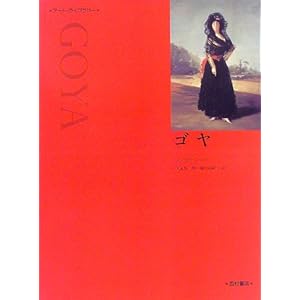

出版社/著者からの内容紹介
富と貧困,繊細な美と恐怖,宮廷での立身出世と痛烈な社会風刺.激動の時代を生きたスペインの首席宮廷画家ゴヤは,王室の輝かしい肖像画とともに,つぎつぎと心に浮かぶ独創的なイメージを描き続けた.矛盾に満ち謎の多いゴヤの全画業を当時の政治・経済・社会問題の中に位置づけ,各国への影響を跡付け,その実像にせまる. --このテキストは、 単行本 版に関連付けられています。
版に関連付けられています。
内容(「BOOK」データベースより)
本書では、その作品と残された文献資料から、この芸術家の人間性について何が導きだされうるかが探求されるであろう。ここではとくに、ゴヤの芸術を彼の生きた時代のスペインという文脈のなかに位置づけ、政治的、経済的、社会的問題がどの程度までゴヤの物の見方を浸食したのか、あるいは先鋭にしたのかを、考察する。 --このテキストは、 単行本 版に関連付けられています。
版に関連付けられています。
内容(「MARC」データベースより)
肖像画家として、また革命的な風刺版画の巨匠として高く評価されるスペイン屈指の天才宮廷画家・ゴヤ。その代表作48点をカラーで紹介するほか、作品解説や略年譜、作品リストも併せて収録する。〈ソフトカバー〉
Amazon.com
This paperback edition of the award-winning study of the life and work of Goya is filled with the same fine reproductions as the original 1994 hardcover. Goya was one of Spain's greatest and most controversial painters, famous for incisive portraits and the "black" paintings of his later years. Scholars have often attributed Goya's progression from producing light-hearted court paintings to creating somber images of the Napoleonic wars to the artist's serious illness of 1792, which left him deaf. Writer Janis Tomlinson's aim here is to show a continuity in his work before and after the illness. She sees in Goya's vast output--at least 1,800 works--a vital drive to explore and exploit his personal creativity, which was strengthened by the deafness that cut him off from all but visual communication with the world. With detail supported by formidable research, Tomlinson presents Goya's life chronologically, analyzing his work from icons like the Naked Maya to his Los Caprichos series of etchings with their biting social satire and supernatural imaginings of a world turned upside down. The demonic intensity of Saturn Devouring His Son and Witches Sabbath, painted on the walls of his "Country House of a Deaf Man" at the end of his life, suggest to some the work of an embittered madman. Rather, these disturbing paintings reflect Goya's profound empathy for the victims of a predatory and unjust society--empathy that a modern audience readily shares. --John Stevenson
--このテキストは、 ハードカバー 版に関連付けられています。
--このテキストは、 ハードカバー 版に関連付けられています。
From Publishers Weekly
Modern interpretations of Goya as a political artist, proto-Romantic rebel, fantasist or realist capture partial truths about the protean Spanish painter, suggests Columbia University art history professor Tomlinson in this meticulous, sumptuously illustrated study featuring 210 color and 70 black-and-white plates. By viewing Goya's career as a lifelong experiment with image-making, she shows how his art became a self-perpetuating process as his works fed off one another. Tomlinson argues unpersuasively that Goya's royal portraits, usually seen as savage satires, actually evince sympathy for his often homely or awkward subjects. She is more successful in elucidating his kaleidoscopic view of evil in the Los Caprichos etchings, his innovative small-scale oils and his investigations of irrationality and destructiveness in scenes of madhouses, war, the Inquisition and popular spectacles.
Copyright 1994 Reed Business Information, Inc. --このテキストは、 ハードカバー 版に関連付けられています。
Copyright 1994 Reed Business Information, Inc. --このテキストは、 ハードカバー 版に関連付けられています。
Book Description
This volume, one in a series of lavishly illustrated paperback books on major artists and their works, tells the story of Goya. From a look at the artist's life and times, to the historical and social context in which he worked, to an analysis of his masterpieces, this is a vital visual resource with more than 300 superb full-color illustrations. The fact-based text is aimed at the general reader, and makes the series perfect for art-history students and art lovers of all ages.
--このテキストは、絶版本またはこのタイトルには設定されていない版型に関連付けられています。
--このテキストは、絶版本またはこのタイトルには設定されていない版型に関連付けられています。
From the Publisher
Goya is sometimes called the last of the Old Masters and the first of the Moderns, and his work has left a lasting impression on avant garde artists from Manet to Picasso. This paperback volume offers an introduction to Goya and covers all aspects of his work: oil, fresco, etching, lithography, chalk and pen. In his lifetime, Goya worked for some of the most prestigious Spanish patrons. For most of his career he was court painter, and yet he also produced some of the most compelling images of social unrest of the last century. The book opens with an introduction to the artistic milieu in Saragossa, where Goya received his earliest training. It moves on to explain the growth of his career in Madrid where he eventually became the most prominent painter at court before and after the French occupation of his country. Throughout the text, Goya's work is set in its political and social context. The work ends with a discussion of his influence on such artists as Manet, Ensor and Picasso.
--このテキストは、絶版本またはこのタイトルには設定されていない版型に関連付けられています。
--このテキストは、絶版本またはこのタイトルには設定されていない版型に関連付けられています。