

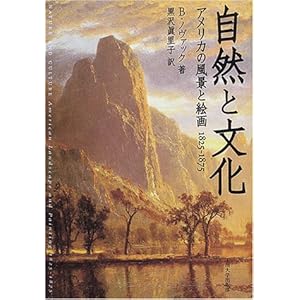

内容(「BOOK」データベースより)
 文化的文脈―哲学的、精神的、科学的―を解明」しようと試みた初めての研究書である。
内容(「MARC」データベースより)
Book Description
explains that for fifty extraordinary years, American society bestowed in the idea of Nature its most cherished ideals. Between 1825 and 1875 all kinds of Americans--artists, writers, scientists, as well as everyday citizens--believed that God in Nature could resolve human contradictions, and that nature itself confirmed the American destiny. During these years Nature, God, and Man converged to become a trinity, and it was through the landscape painters, the leaders of this intellectual movement, that the nation was reminded of divine benevolence "by keeping before their eyes the mountains, trees, forests, and lakes." Using diaries and letters of the artists as well as quotes from literary texts, journals, and periodicals, Novak illuminates the range of ideas projected on to the American landscape by painters such as Thomas Cole, Albert Bierstadt, Frederic Edwin Church, Asher B. Durand, Fitz Hugh Lane, and Martin J. Heade, and writers such as Ralph Waldo Emerson, Henry David Thoreau, William Wordsworth, Theodore Rousseau, and Frederich Wilhelm Schelling.
Adding a rich new dimension to the discussion of nature's influence in America, Novak explains how religion, philosophy, science, and literature served as the support system for the idea of God in Nature. She shows that the idea of nature as a national vested interest was invaluable to a young expanding nation, but ultimately this essentially monolithic view collapsed from within, undermined by the Civil War, Darwinism, and a burgeoning technological landscape. Taking American landscape painting in its golden era as a product of society, she examines the cultural background of paintings as an index to their intrinsic meaning. She explains, for example, how new discoveries in science were made consonant with Deity, how religion itself permeated nature with the idea of Creation, and how the landscape artists were given the task of providing the images of nature that became the national iconography. Novak goes on to demonstrate how American landscapists, handling rocks, clouds, plants, and other natural elements, paralleled and diverged from scientific developments, and also how the artists who accompanied explorers on their westward expeditions related to their scientific colleagues.
Now with a new preface, this incisive volume encompasses a vast cultural panorama. It beautifully demonstrates how the influence of the nature served, not only as a vehicle for artistic creation, but as its ideal form.
--このテキストは、絶版本またはこのタイトルには設定されていない版型に関連付けられています。
出版社 玉川大学出版部
上の発見と風景画との関係、また、南米・中央アジアを踏査したドイツの地理学者アレクサンダー・フォン・フンボルトが、アメリカの風景画家に与えた影響など、興味は尽きない。
著者略歴 (「BOOK著者紹介情報」より)
1951年
バーナード大学卒業、’57年ラドクリフ大学より博士号取得。ピッツバーグ大学客員教授、コロンビア大学およびバーナード大学美術史学部長を経て、’98年退職。バーナード大学名誉教授。著書に「American Painting of the Nineteenth Century」などがある黒沢 真里子
1976年
津田塾大学学芸学部英文科卒業。筑波大学大学院修士課程地域研究科入学後、国際ロータリークラブ奨学金を得て米国ペンシルヴァニア大学大学院へ留学。’80年筑波大学大学院修士課程地域研究科修了(学術博士)。’99年桜美林大学大学院国際学研究科博士課程修了。現在、昭和女子大学短期大学部非常勤講師(本データはこの書籍が刊行された当時に掲載されていたものです)