

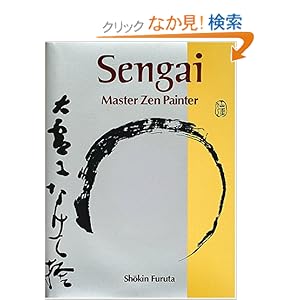

Book Description
 : Master Zen Painter is the portrait of a Japanese Zen priest of the mid-eighteenth century whose work embodies the essence of humor in the Zen tradition. Sengai was a Zen master with a profound insight into life, but more importantly he was able to express this insight in ink paintings and calligraphy that are replete with wisdom, simplicity, and humor.
Sengai
This concise, acute narrative of Sengai
Sengai
For those interested in Zen, calligraphy, or art, Sengai
内容(「MARC」データベースより)
Book Description
: Master Zen Painter is the portrait of a Japanese Zen priest of the mid-eighteenth century whose work embodies the essence of humor in the Zen tradition. Sengai was a Zen master with a profound insight into life, but more importantly he was able to express this insight in ink paintings and calligraphy that are replete with wisdom, simplicity, and humor.
Sengai
This concise, acute narrative of Sengai
Sengai
For those interested in Zen, calligraphy, or art, Sengai
From the Publisher
Parenthetical numerals refer to catalogue numbers in Idemitsu Bijutsukan zohin zuroku: Sengai
FIGURES
1 (338) The First Patriarch Senko (Yosai). Hanging scroll, ink on silk.
2 (1019) Spring Charms in a Life of Quietude. Hanging scroll, ink on paper.
3 (422) To Saito Shoho. Hanging scroll, ink on paper.
4,5 (426) Kitafune Rice Dealer; Rice Dealer Jintaro. Pair of hanging scrolls, ink on paper.
6 (425) Ichimaru Iwane. Hanging scroll, ink on paper.
7 (1050) Tanka Composed in the Spring of the Year of Beiju. Dated 1837. Hanging scroll, ink on paper.
8 (120) Hotei (Sakyamuni had already returned to the forest of the twin sala trees. Hanging scroll, ink on paper.
9 (250) Sensu. Hanging scroll, ink on paper.
10 (249) Kensu. Hanging scroll, ink on paper.
11 (269) Hyakujo yako (Hyakujo and the Wild Fox). Dated 1808 Hanging scroll, ink on silk.
12 (144) Hotei (Law is for drawings in the world). Hanging scroll, ink on paper.
13 (730) Tiger. Hanging scroll, ink on paper.
14 (77) Daikoku (The God of Fortune). Hanging scroll, ink on paper.
15 (903) One-line Calligraphy (Drink). Hanging scroll, ink on paper.
16 (490) Cherry Blossom Viewing. Hanging scroll, ink on paper.
17 (221) Bodhidharma. Hanging scroll, ink on paper.
18 (885) Circle, triangle, square. Hanging scroll, ink on paper.
19 (890) The Circle Aspect. Hanging scroll, ink on paper.
20 (60) The Three Gods of Happiness. Hanging scroll, ink on silk. 40.6 x 47.1 cm.
21 (86) Sagicho. Hanging scroll, ink on paper.
22 (83) Daikoku. Hanging scroll, ink on paper.
23 (639) The Monument to the End of the Brush. Dated 1832. Hanging scroll, ink on paper.
PLATES
1 (1058) The Heart Sutra of Wisdom. Dated 1823. Hand scroll, ink on paper.
2 (1) Amida Buddha. Dated 1828. Hanging scroll, ink on paper.
3 (8) Sakyamuni Coming out of the Mountains. Hanging scroll, ink on paper.
4 (23) Kannon. Dated 1827. Hanging scroll, ink on silk.
5 (58) The Seven Deities of Happiness. Hanging scroll, ink on paper.
6 (61) The Three Deities of Happiness. Hanging scroll, ink on paper.
7 (148) Hotei Pointing to the Moon. Hanging scroll, ink on paper.
8 (175) Kanzan and Jittoku. Hanging scroll, ink on paper.
9 (212) The Hannya Mask. Hanging scroll, ink on paper.
10 (213) Bodhidharma. Hanging scroll, ink on paper.
11 (231) Baso and Rinzai. Pair of hanging scrolls, ink on paper.
12 (251) Nansen Cuts the Cat. Hanging scroll, ink on silk.
13 (240) Kyogen Hits the Bamboo. Hanging scroll, ink on paper.
14 (296) Above Kokei Ravine Three Hermits Are Laughing. Hanging scroll, ink on paper.
15 (309) Harmony between Heaven and Earth. Hanging scroll, ink on paper.
16 (311) Prince Shotoku. Hanging scroll, ink on paper.
17 (338) The First Patriarch Senko (Yosai). Hanging scroll, ink on silk.
18 (368) Self-Portrait. Hanging scroll, ink on paper.
19 (428) The Gate Pines for the New Year. Pair of hanging scrolls, ink on paper.
20 (473) The Six Poetic Geniuses in Old Age. Hanging scroll, ink on paper.
21 (485) Hiodoshi, Sumo Wrestler. Hanging scroll, ink on paper.
22 (489) The Grand Sumo Tournament. Dated 1834. Hanging scroll, ink on paper.
23 (501) oharame, Women Peddlers from ohara. Hanging scroll, Ink on paper.
24 (515) A Broken Piece of Rope. Hanging scroll, ink on paper.
25 (562) Hakozaki Beach. Hanging scroll, ink on paper.
26 (616) In Memory of the Tokian Hermitage of Zen Master Jomyo. Dated 1823. Hanging scroll, ink on paper.
27 (626) Sardine Nets. Hanging scroll, ink on paper.
28 (651) Wooden Pestles and a Ladle. Hanging scroll, ink on paper.
29 (666) A Broken Tub. Hanging scroll, ink on paper.
30 (741) Dragon and Tiger. Pair of hanging scrolls, ink on paper.
31 (751) Monkeys Trying to Catch the Moon. Hanging scroll, ink on silk.
32 (762) Two Cranes. Hanging scroll, ink on silk.
33 (777- Basho and the Frog. Triad of hanging scrolls, ink on paper.
34 (776) The Meditating Frog. Hanging scroll, ink on paper.
35 (798) The Plum Tree. Hanging scroll, ink on paper.
36 (933 One-line Calligraphy and Bamboo (The mugwort). Pair of hanging scrolls, ink on paper.
37 (834) The Full Moon in Mid-Autumn. Hanging scroll, ink on paper.
38 (837) The Forbearing Willow. Hanging scroll, ink on paper.
39 (841) The Morning Glory. Hanging scroll, ink on paper.
40 (853) The Orchid. Hanging scroll, ink on paper.
41 (874) The Turnip. Hanging scroll, ink on paper.
42 (879) Lotus Pond. Hanging scroll, ink on silk.
43 (885) Circle, triangle, square. Hanging scroll, ink on paper.
44 (888) The Autumn Moon. Hanging scroll, ink on paper.
45 (887) The Aspect of One Circle. Hanging scroll, ink on paper.
46 (891) Two-character Calligraphy (Nothing Special). Hanging scroll, ink on paper.
47 (894) One-line Calligraphy (Spring color). Hanging scroll, ink on paper.
48 (905) One-line Calligraphy (Kyogen). Hanging scroll, ink on silk.
49 (903) One-line Calligraphy (Drink). Hanging scroll, ink on paper.
50 (900) One-line Calligraphy (One good). Hanging scroll, ink on paper.
51 (908) One-line Calligraphy (The wondrous). Hanging scroll, ink on paper.
52 (917) One-line Calligraphy (One who). Hanging scroll, ink on paper.
53 (898) One-line Calligraphy (Spring is). Hanging scroll, ink on paper.
54 (915) One-line Calligraphy (Leave). Hanging scroll, ink on paper.
55 (920) One-line Calligraphy (Outside). Hanging scroll, ink on paper.
56 (928) One-line Calligraphy (No wealth). Hanging scroll, ink on paper.
57 (1002) Calligraphy of a Poem (Daytime in my room). Hanging scroll, ink on paper.
58 (1003) Calligraphy of a Poem (The tradition tells: to hear Buddha). Hanging scroll, ink on paper.
59 (1031) Calligraphy of a Poem (Once I followed Ryomyo). Hanging scroll, ink on paper.
60 (971) Three-character Calligraphy (Turning). Tablet, ink on paper.
61 (983) Two-character Calligraphy (Forbearance). Hanging scroll, ink on paper.
62 (984) Sweets for Tea. Hanging scroll, ink on silk.
63 (989) Framed Calligraphy (Buddhas and bodhisattvas all). Tablet, ink on paper.
64 (1077) Words on the Tea Ceremony. Dated 1826. Hanging scroll, ink on paper.
65 (1046) Poem on the Buddha Way. Hanging scroll, ink on paper.
66 (1049) Waka Poems (Summer night,). Pair of hanging scrolls, ink on paper.
67 (1081) A Letter. Hanging scroll, ink on paper.
68 (977) A Pseudonym. Fan, ink on paper.
69 (1071) A Dream Story. Hanging scroll, ink on paper.
70 (1070-16) Family Precept. Hanging scroll, ink on paper.
71 (1137) A Tea-bowl Box. Wooden box.
72 (1131) Takatori Ware Ewer.
73 (1135 Tea-scoops and Cases Made and Named by Sengai
74 (1078) Note on a Tea-scoop. Dated 1821. Hanging scroll, ink on paper.
About the Author
's birthplace. Furuta's early life shows similarities to that of his predecessor. Like Sengai, who became a monk when he was ten or eleven following an apparent family financial crisis, the nine-year-old Furuta was sent to a small Zen temple soon after his father's death at the age of thirty-five. Nearly eighty years later Furuta vividly recalls the day he left home. His sad mother accompanied him to a local bus stop, but simply stood there in silence, unable to lift her head as she saw him off.
Furuta endured the austere life of an acolyte at the Zen temple, but was not destined to become a priest. With humor and a deep sense of gratitude, he describes how he instead became a Buddhist scholar: his sutra-chanting was so out of tune that parishioners were unappreciative and he decided to give up the vocation of a priest. But the young Furuta, again like Sengai
Out of gratitude for the head priest's generosity, Furuta worked hard when he became a student of philosophy at the Imperial University of Tokyo, spending many hours in the library and satisfying his hunger with scraps of food. In his second year in the graduate program of the department of philosophy Furuta discovered Daisetsu Suzuki's introductory book on Zen Buddhism written in English. Inspired by it, he went to meet Suzuki, and an unofficial master-disciple relationship developed over the course of Furuta's repeated visits.
In July 1966, after Suzuki's death, Furuta succeeded him as the second director of the Matsugaoka Bunko Foundation, which was established in December 1945 with the partial support of Mr. Sazo Idemitsu. Located in Kamakura, the foundation has charge of the massive Suzuki library. At the age of eighty-nine Furuta is still actively involved as director of the foundation in a new forty-volume edition of Suzuki's works, which is now being published by Iwanami Shoten.
Retired from professorships at Nihon University and the University of Hokkaido, Furuta continues to lecture as a guest-professor at Hana- zono University in Kyoto. Besides the fourteen-volume Collected Works of Furuta Shokin (1980-81), he has published many other books and articles on Buddhism, and especially on Zen and its relationship to the arts. His publications also include collections of his calligraphy, drawings, and haiku poetry.
The Translator
Reiko Tsukimura, Professor Emeritus at the University of Toronto, was born in Tokyo and studied at Japan Women's University. She received a Ph.D. in comparative literature from Indiana University and has held academic positions at the University of British Columbia, Harvard University, the University of Minnesota, and the University of Toronto, where she taught for twenty-one years. Now retired, she continues to conduct research on Japanese literature and Buddhism, and to lecture on haiku in the Continuing Studies Program, University of Victoria, while enjoying her hobbies of year-round gardening, hiking, and painting. Her many articles in English and Japanese deal with the dynamic interplay between Japanese and Western culture and between tradition and modernity. She has translated, among other works, The Lake (1974), a novel by Yasunari Kawabata, and I Am Alive: The Tanka Poems of Goto Miyoko, 1898-1978 (1988). She also edited, and wrote the introduction for, Life, Death and Age in Modern Japanese Fiction (1978).