

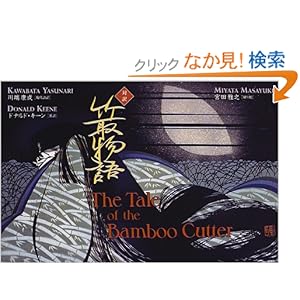

出版社/著者からの内容紹介
ノーベル賞作家の現代語訳と傑出した芸術家の作品、そして日本文学の研究に一生を捧げたジャパノロジストの翻訳が渾然一体となり生み出された、大人のための「竹取物語」。
The classic, charming fairy tale retold by Yasunari Kawabata.
"Masayuki Miyata's bright, bold illustrations perfectly complement this elegant bilingual edition, and Keene has outdone himself in find English equivalents fo the outrageous puns that punctuate the story." -The New Yorker
内容(「BOOK」データベースより)
ノーベル賞作家の現代語訳と傑出した芸術家の作品と、日本文学の研究に一生を捧げたジャパノロジストの翻訳が合体した空前絶後の『竹取物語』。
内容(「MARC」データベースより)
かぐや姫は無邪気な少女などではない。彼女の一番の特徴である冷酷さを出したドナルド・キーンによる英訳と、川端康成による現代語訳、切り絵の第一人者・宮田雅之の作品が合体した空前絶後の「竹取物語」。
著者について
Modern rewriting: YASUNARI KAWABATA (1899-1972)
Born in the city of Oaka, he attended Ichiko in Tokyo, and graduated from the Department of Literature at Tokyo Imperial University. He made his debut into literary circles when Kikuchi Kan praised the fresh sensibility of his story "Shokonsai ikkei" ("A view of the Yasukuni Festival"), when it was published in the sixth issue of the literary journal Shinshicho. With Yokomitsu Riichi and Kon Toko in 1924 he set up the literary journal Bungei jidai. These writers drew attention for their fresh, innovative writing, and they were named the Shinkankakuha ("The New Sensiblility Group").
Kawabata is known for his realist pieces like "Jurokusai no nikki" (Diary of My Sixteenth Year, a diary of his middle-school days published in 1925), and "Izu no Odoriko" (The Izu Dancer, 1926), but he also wrote a lot of highly poetic pieces like "Nijunen" (Twenty years, 1925), "Tataku ko" (1928), and mod-ernist works like Asakusa kurenaidan (Scarlet Gang of Asakusa, 1929-30). With the new psychological novel Suisho genso (Quartz Illusions, 1931), his works became more nihilistic, a tendency which only grew deeper with works like Kinju (Birds and Beasts, 193'3) and Niji (Rainbow, 1934). In his most famous novel Yukiguni (Snow Country, 1935-47) his writing dealt with figures who struggled their best to survive.
Kawabata became the Chairman of the Japan Pen Club in 1948. In 1957 he chaired the Conference of the International Pen Club in Tokyo. In 1961 he was awarded a Cultural Medal, and in 1968 the Nobel Prize for Literature. However, by this time his health and spirits were impaired by sleeping medicine, and in 1972, at the height of acclaim, he killed himself in his study using gas.
Translation: DONALD KEENE (1922- )
Donald Keene
 , an American scholar of Japanese literature, was born in New York in 1922. He graduated from Columbia University where he first began the study of Japanese in 1941. During World War II he served in the U.S. Navy as a translator and interpreter of Japanese. After the war he returned to academic life. Form 1948 to 1953 he taught Japanese at Cambridge University. He received the Ph.D. degree from Columbia University in 1951 with his study of The Battles of Coxinga, the play by Chikamatsu Monzaemon.
 He returned to Columbia University in 1955 after two years' study at Kyoto University, and he taught there until 1992
, when he retired as University Professor Emeritus. His publications ranging in time from a study of the Kojiki to discussions of contemporary literature, has increased appreciation of Japanese literature in other countries. His honors include the Kikuchi Kan Prize, awarded in 1962, the Order of the Rising Sun, Third Class (1975), the Japan Foundation Award (1984), the Tokyo Metropolitan Prize (1987), and Fukuoka Asian Culture Prize (1991). He is a foreign member of the Japan Academy... He is also a member of the American Academy and Institute of Arts and Letters. His book Travelers of a Hundred Ages, Published in 1984, received both the Yomiuri Literature Prize and the Shincho Grand Prize. His considerable research into Japanese literature and contribution to its introduction outside Japanese was recognized with the Asahi Prize in 1998. Other publications include the four-volume history of Japanese literature, consisting of Seeds in the Heart, World Within Walls, and the two volumes of Dawn to the West, as well as numerous translations of both classical and modern works.
Since his retirement from Columbia University he has been active as a writer and lecturer.
Illustrations: MASAYUKI MIYATA (1926-1997)
Masayuki Miyata was born in Akasaka, Tokyo in 1926. He was discovered by the distinguished writer Tanizaki Jun'ichiro, and he went on to create his own distinct realm in kiri-e (cut-out illustrations). His cut-out pictures, made with mere sheets of paper and a cutting blade, and their exceptional accessibility to people from all countries, have won admiration. In 1981, his work Japanese Pieta was selected for the modem religious art collection in the Vatican Museum-he is only the fourth Japanese artist so honored this century. In 1995, the bi-centennial anniversary of the UN, Miyata was selected from contemporary artists worldwide to be the UN's official artist, the first Japanese to hold the post. His masterpiece, Red Fuji, was reproduced in special limited edition in 184 countries around the globe. Miyata continued to be actively engaged in international art circles as the most prominent kiri-e artist in Japan until his death in 1997.
His representative works include illustrations for Oku no Hosomichi (The Narrow Road to Oku), Taketori monogatari (Tale of a Bamboo-Cutter), Man'yo koi-uta (Poems of Love from the Man'yoshu), and Hana no Ran (Passion in Disarray).