

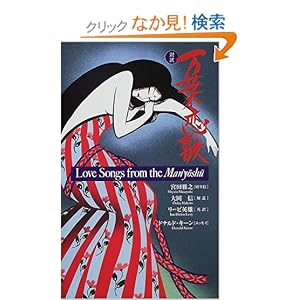

出版社/著者からの内容紹介
1200年の歳月を越え、現代人の心に深く 響きあう万葉集の恋歌35作品を厳選して収録。3大家の技巧と英知が紡ぎだした「世界文学」としての万葉集が味わえます。
響きあう万葉集の恋歌35作品を厳選して収録。3大家の技巧と英知が紡ぎだした「世界文学」としての万葉集が味わえます。
The most passionate love poems of ancient Japan, expertly translated and explained, and set alongside the original Japanese and a beautiful visual "translation" by one of Japan's most distinguished artists.
内容(「BOOK」データベースより)
3大家の技巧と英知が紡ぎだした万葉・恋の世界!万葉集の中から恋歌35首を厳選。
内容(「MARC」データベースより)
1200年の歳月を越えて現代人の心に響き合う、「世界文学」としての万葉集の新しさ。恋歌35首を厳選、エロスの微妙な動きを美しい切り絵に「翻訳」した宮田雅之の名作と大岡信の解説で味わう。英文併記。〈ソフトカバー〉
著者について
MIYATA MASAYUKI
Cut-out illustrator. Born in Tokyo in 1926. He was discovered by the distinguished writer Tanizaki Jun'ichiro and went on to create his own distinct realm in kiri-e (cut-out illustrations). In 1995, Miyata was selected from among contemporary artists worldwide to be the UN's official artist. Miyata's representative works include illustrations for The Narrow Road to Oku, The Tale of Genji and The Tale of the Bamboo Cutter.
OOKA MAKOTO
Poet and literary critic. Born in Shizuoka Prefecture in 1931. His Kioku to genzai (1956, Memory and the Present) is a volume of poems rich in intellectual lyricism. Among his other writings are Toji no kakei (1969, Lineage of a Profligate); Ki no Tsurayuki (1971), a study of the poet who compiled the Kokinshu poetic anthology; and Nihon shiika kiko (1978, Travels through Japanese Poetry).
IAN HIDEO LEVY
Novelist and scholar of Japanese literature. Born in California in 1950 and educated in Taiwan, America and Japan. He received the American Book Award in 1982 for his translation of the classic Japanese poetry anthology, the Man'yoshu. He won the coveted Noma Prize for New Writers for his novel, written in Japanese, Seijoki no kikoenai heya (1992
, The Room Where the Star-Spangled Banner Cannot Be Heard). DONALD KEENE
U.S. scholar and translator of Japanese literature. Born in New York City in 1922. His scholarly publications, ranging from a study of the Kojiki to discussions of contemporary literature, have established the foundations for the appreciation of Japanese literature in the West. He has been awarded the Kikuchi Kan Prize (1962), the Order of the Rising Sun (1974), the Japan Foundation Award (1984), and the Asahi Prize (1998).